
Dreamscape Guide
From Curriculum Mastery to Real-World Decision-Making
Dreamscape One begins with a child learning the fundamentals, but its wider goal is to create more opportunities to use knowledge, exercise judgement and become increasingly independent.
There is a false choice in education between academic fundamentals and “real-world skills.” Children need both. A learner who cannot read carefully, calculate confidently or understand basic scientific ideas has fewer tools to apply later. At the same time, knowing a fact is not the same as knowing what to do with it.
Dreamscape One is built around connecting those stages rather than choosing one side.
Build knowledge and fluency.
Use knowledge under different conditions.
Make progress visible and persistent.
Choose between competing uses and outcomes.
Create something that develops through repeated choices.
Mastery is the starting point, not the finish line
Curriculum learning gives children a toolkit. Reading comprehension allows them to interpret information. Mathematics helps them quantify and compare. Science builds ways of explaining how the world works.
These foundations matter even when the eventual problem does not look like a school question. A budget, a business decision or a comparison of alternatives still depends on understanding information accurately.
Thinking needs different conditions
A learner can become very good at recognising a familiar question format without becoming equally comfortable with uncertainty. That is why Dreamscape includes experiences that change the context.
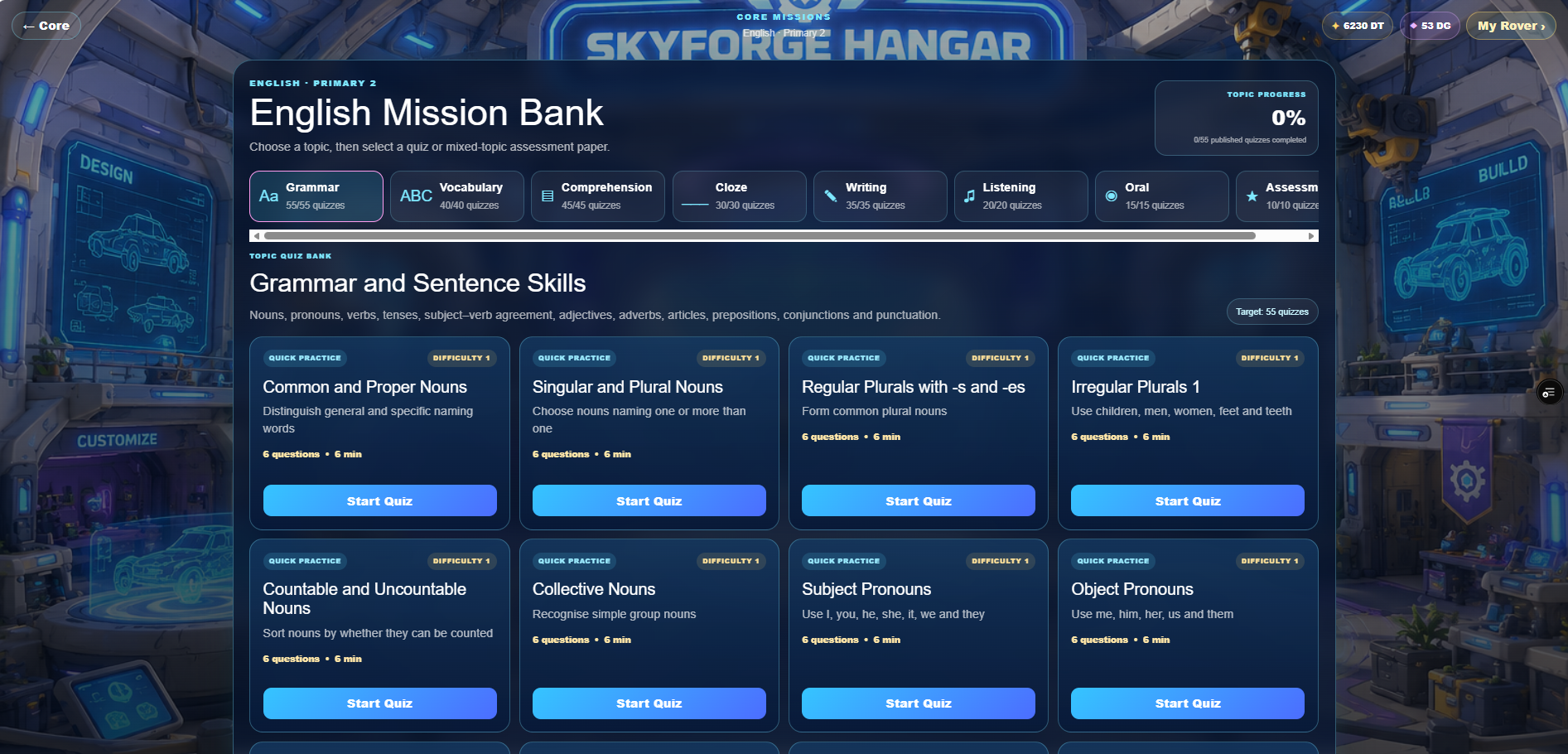
Think Lab can emphasise memory, sets and reasoning. Knowledge Arena adds pace and pressure. Other game systems ask learners to manage upgrades or persist through a longer challenge.
The purpose is not to claim that a game automatically transfers a skill into everyday life. Transfer is difficult. What Dreamscape can do is provide repeated opportunities to use attention, reasoning and decision-making under conditions that differ from a standard worksheet.
Rewards create the first real trade-offs
Once progress creates a limited resource, the learner has something to manage. Dream Tokens can be spent in more than one place. Saving for a rover upgrade may mean delaying a purchase elsewhere.
That decision is still simple, but it introduces an important idea: choices have competing uses. The learner is no longer only trying to maximise a score.
Milo raises the complexity
Milo's World takes the same basic structure and adds uncertainty, ownership and longer time horizons. A fictional asset may change in value. A purchase may have an opportunity cost. A business decision may improve one part of an operation while making another more expensive.

This is why Milo is designed mainly around ages 12+. The difficulty is higher, not because a birthday suddenly makes someone financially literate, but because the learner is expected to compare alternatives and tolerate less certain outcomes.
Building creates longer-term responsibility
A persistent system changes the meaning of a decision. If an upgrade or business choice affects what happens later, there is more reason to think beyond the immediate reward.
Nova's Home, Skyforge and the developing Business Builder all use this principle in different ways. The learner is not just finishing isolated rounds. They are changing something that remains.
Why low-stakes mistakes matter
Children need environments where a wrong choice is informative rather than catastrophic. A fictional market or business simulation can create enough consequence to make reflection meaningful while still allowing the learner to try again.
Some decisions involve uncertainty. A sensible choice can still lead to a poor result, and a weak choice can occasionally get lucky. The useful habit is learning to review the reasoning, not only the result.
Where parents fit into this progression
NOVA+ helps parents see the academic evidence underneath the world. That matters because an engaging game experience should not make learning invisible.
At the same time, parents can ask about decisions that a dashboard cannot fully capture: Why did you choose that? What were you trying to achieve? What would you do differently? Those conversations are part of how a virtual choice becomes a more useful learning experience.
What Dreamscape is not claiming
Dreamscape does not assume that completing a game makes a child financially sophisticated, entrepreneurial or automatically independent. It also does not treat academic knowledge as outdated because real-world skills matter.
The goal is more modest and more practical: build strong foundations, then create increasingly rich opportunities to use them.
The direction of the whole ecosystem
The progression can be summarised simply: Learn → Think → Earn → Decide → Build.
Nova begins closer to curriculum mastery and cognitive challenge. Milo moves further into resources, risk, business and judgement. NOVA+ gives parents a parallel view of the learning evidence developing underneath.
Dreamscape One is intended to grow with the learner rather than remain fixed at one age, one subject or one type of activity.
Continue with Dreamscape
See the full journey in one place
Read the flagship How Dreamscape One Works guide, or explore why money and business are part of the later-stage learning experience.
Continue Exploring