
Dreamscape Guide
A Parent’s Guide to Dreamscape One
Dreamscape One combines structured learning, game worlds, rewards, parent insights and later-stage financial and business experiences. This guide explains what each part is for and how families can approach it.
Dreamscape One is designed to give children more than a sequence of quizzes. The academic work still matters, but progress can continue into thinking challenges, upgrades, world-building, financial choices and parent-facing learning insights.
For parents, the most useful way to think about Dreamscape is not as one game and not as one worksheet platform. It is a connected ecosystem with different parts serving different purposes.
Nova is the main learning and thinking world. NOVA+ helps parents understand learning evidence. Milo introduces harder ideas around money, value, business and decision-making, with difficulty designed mainly for ages 12+.
Who is Dreamscape One for?
Nova is built primarily around primary-school learners. Its curriculum experiences are organised around school learning, while its wider world gives children reasons to use rewards, revisit spaces and continue progressing.
Milo's World is designed mainly for learners around age 12 and above. That is a difficulty guide rather than an age gate. Confident younger learners who are ready for more complex money, business and decision-making ideas can explore earlier.
Readiness matters more than forcing every child into the same timeline. A younger learner may enjoy some Milo activities immediately, while another learner may benefit from spending more time building foundations in Nova first.
What does a learner actually do in Nova?
Nova's World brings together curriculum work and wider game experiences. Learning Missions provide structured academic practice. Think Lab focuses on reasoning, memory and related thinking skills. Knowledge Arena turns knowledge into a faster interactive challenge. Nova's Home and Skyforge give earned progress somewhere to accumulate.
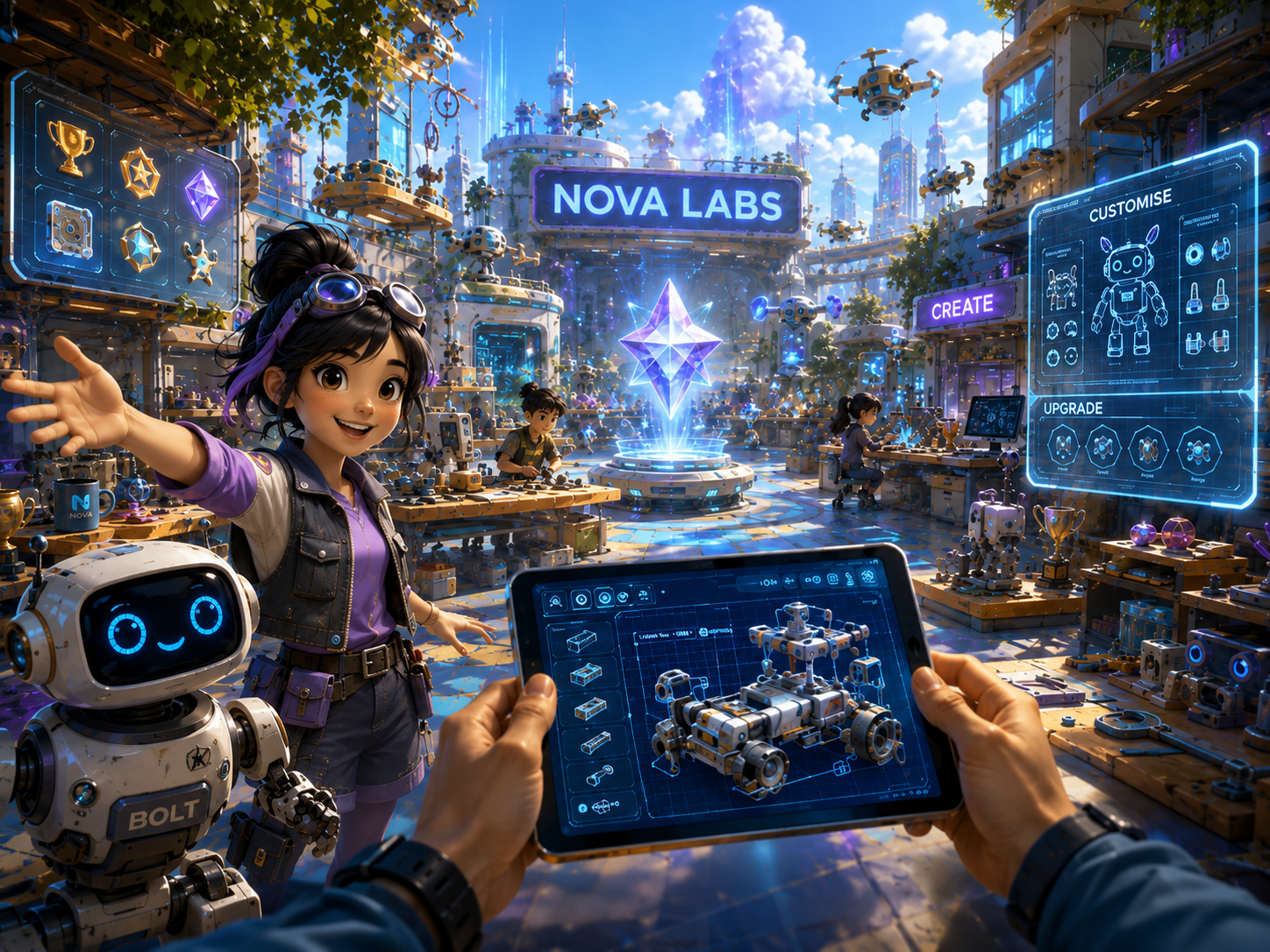
The purpose of the surrounding world is not to hide weak educational content behind animation. The learning task still needs to be accurate, appropriately difficult and useful. The world exists to make progress feel connected and worth returning to.
What subjects are part of Dreamscape?
Dreamscape's curriculum system is built around English, Mathematics and Science across primary levels. Public access to particular subjects can depend on the current plan and rollout stage, so the pricing page is the best place to check what is included in each active membership.
Within the platform, learning is organised at topic and concept level so progress can become more useful than a single overall percentage. Assessments and repeated activity can then contribute evidence to the wider learner picture.
What are Dream Tokens and Dream Gems?
Dream Tokens, or DT, are the main virtual currency used across Dreamscape. Learners can earn them through eligible activity and use them in parts of the world for upgrades, purchases and decisions.
Dream Gems, or DG, are a more specialised reward connected to eligible learning completion. The two currencies serve different purposes, but both are designed as in-platform virtual rewards, not real-world money.
The important learning idea is what happens after a reward is earned. Once resources are limited, a learner has to choose whether to spend, save, upgrade or use them in another part of the ecosystem.
What does NOVA+ show parents?
NOVA+ is the parent-facing intelligence layer. It is designed to move beyond “your child scored 80%” and organise evidence into a clearer view of recent learning, strengths, gaps and mastery.
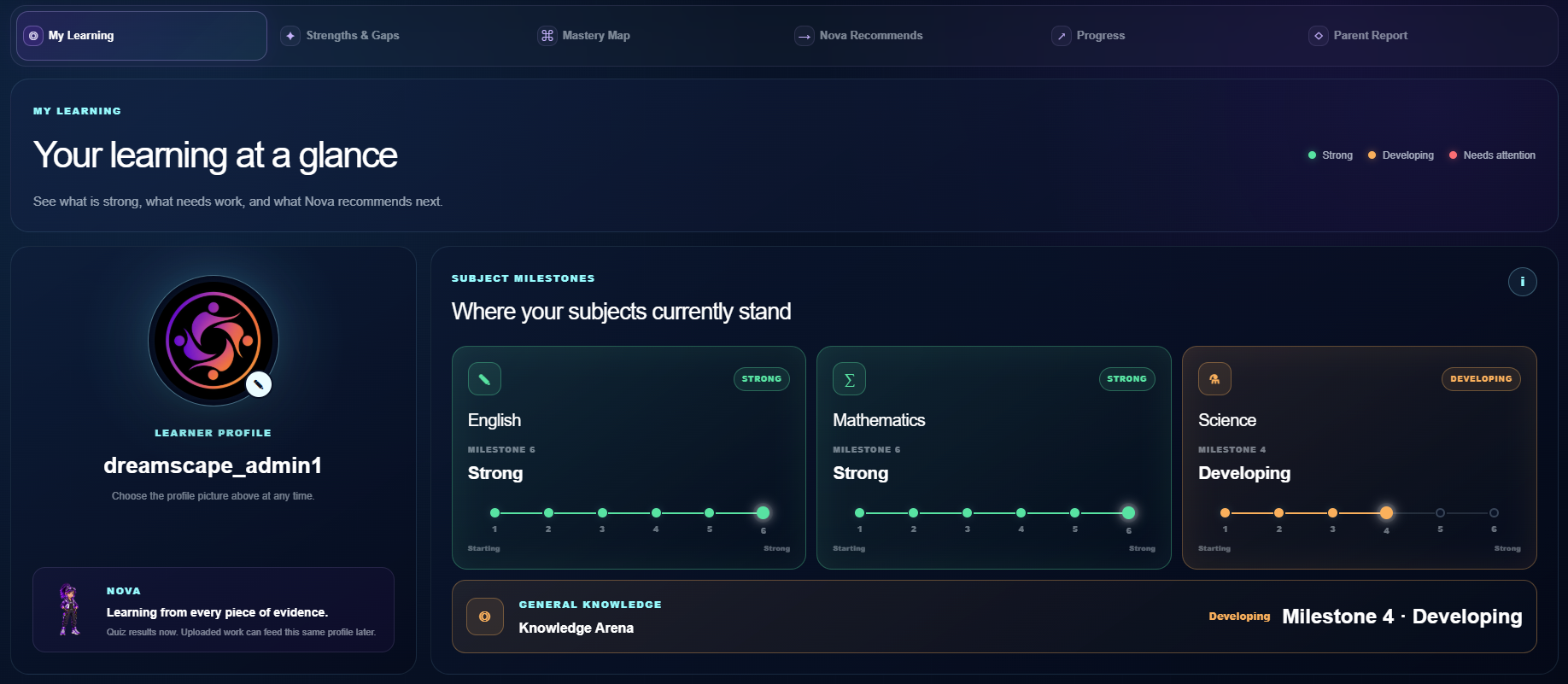
Its major views include My Learning, Strengths & Gaps, Mastery Map and recommendations as the system develops. Parents can also use learning reports when they want a deeper snapshot of progress.
NOVA+ should be read as evidence and guidance, not as a diagnosis of a child. A dashboard cannot see everything a teacher or parent sees. It can, however, make patterns easier to notice and give families a better starting point for deciding what to support next.
What happens in Milo’s World?
Milo changes the type of problem. Instead of focusing mainly on school mastery, Milo asks learners to make choices involving limited resources, spending, value, risk, ownership and eventually business operations.
Milo's Exchange uses fictional stocks and property with Dream Tokens. The Dream Shop creates spending trade-offs. Activity Lab and Quiz Hall give learners additional ways to earn and compete. Business Builder is being introduced as the next step towards operating and growing a simulated business.
Milo's markets are fictional and educational. They are designed to make ideas such as risk, value, opportunity cost and ownership easier to experience without putting real money at risk.
How much should a child use Dreamscape?
There is no single session length that is correct for every learner. Dreamscape is better used consistently than treated as a long compulsory sitting. A child completing focused learning and leaving while still engaged can be more useful than extending a session simply to reach a time target.
Parents can look at the quality of participation rather than only the number of minutes: Is the learner completing work carefully? Are they returning independently? Are the same gaps repeating? Are they making sensible choices with what they earn?
What role should parents play?
Dreamscape is designed to support greater independence, so parents do not need to supervise every question. A more useful role is to check in periodically, review NOVA+ together and ask the learner to explain a decision or show what they have built.
Questions such as “Why did you choose that upgrade?”, “What did you find difficult this week?” or “Why did you keep those Dream Tokens instead of spending them?” can turn the platform into a conversation rather than a monitoring exercise.
How is learning content developed?
Dreamscape uses AI to assist development, organisation and improvement of learning content, while educational content is reviewed by qualified teachers before it reaches learners. The goal is to combine the speed of modern tools with human judgement about accuracy, clarity, curriculum relevance and age appropriateness.
How should parents think about memberships?
Dreamscape's public plans can change as subjects and NOVA+ roll out. Rather than hard-code plan details into an evergreen guide, families should use the current pricing page for active membership options, introductory trials and what each plan includes.
If access later ends, the purpose of cancellation is to stop paid access, not to pretend the learner never used Dreamscape. Saved learning progress and earned virtual rewards are treated separately from whether a paid membership is currently active.
What should I look at first?
If your child is new to Dreamscape, begin with Nova and let the learner experience the system before trying to optimise every feature. Once there is enough activity, NOVA+ becomes more useful because there is real evidence to interpret.
Milo can be introduced when the learner is ready for the additional complexity. The goal is progression, not rushing a child through every part of the ecosystem as quickly as possible.
Continue with Dreamscape
Start with the part that matters most
Explore how Dreamscape works as a whole, or view the current membership options for your learner.
Continue Exploring