
Dreamscape Guide
How Dreamscape One Works
Dreamscape One is designed around a simple idea: learning should build knowledge first, then give children meaningful places to think, make choices and use what they know.
Dreamscape One connects several experiences that would normally sit in separate products. Curriculum practice, thinking games, virtual rewards, world-building, financial literacy and parent insights all share one progression. The purpose is not to make every activity look the same. It is to make progress in one part of the system matter somewhere else.
The easiest way to understand the model is through five verbs: Learn → Think → Earn → Decide → Build. NOVA+ sits across that journey for parents, helping turn the learner's activity into a clearer picture of progress.
Build knowledge and fluency through curriculum practice and structured missions.
Use memory, logic, reasoning and knowledge in challenges that are not simply another worksheet.
Turn progress into visible Dream Tokens and eligible Dream Gems that matter elsewhere in the world.
Choose whether to spend, save, invest, upgrade or take a different path — and see the consequences.
Use what has been earned and learned to develop spaces, rovers, collections and eventually businesses.
Step 1: Learn — build the foundations first
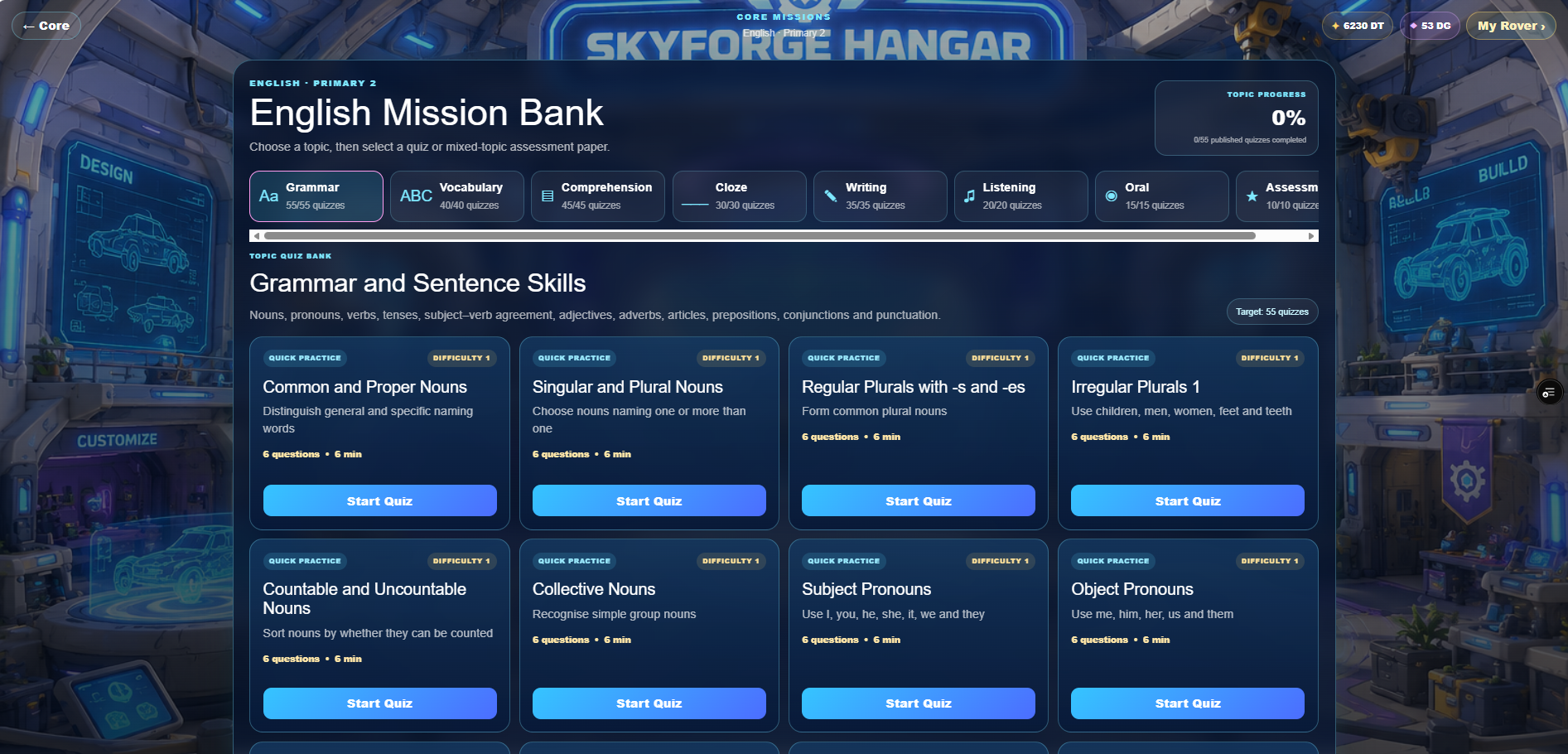
Dreamscape starts with the part that cannot be skipped: children need knowledge and practice. Learning Missions provide structured work across the school curriculum, with English and Mathematics at the centre of the current learner experience and Science forming part of the wider Dreamscape curriculum direction.
A learner may be practising a concept, completing a topic quiz or working through a broader assessment. The important point is that the academic task still has to stand on its own. A correct answer should come from understanding, not from the surrounding game layer.
Step 2: Think — use knowledge in different ways
School knowledge is important, but learning is stronger when children can also hold information in mind, notice patterns, reason through unfamiliar situations and make decisions under pressure. That is why Nova includes experiences such as Think Lab and Knowledge Arena rather than turning every part of the platform into another curriculum quiz.
The Think Lab focuses more directly on cognitive challenges such as logic, sets and memory. Knowledge Arena uses curriculum and general knowledge in a faster, more game-like format. The two experiences feel different because they are meant to exercise different habits.
Dreamscape's teaching still depends on good questions, explanations, progression and evidence. The world gives children a reason to return and a place to use the results of their effort.
Step 3: Earn — make progress tangible
When effort disappears the moment a quiz closes, progress can feel abstract. Dreamscape therefore uses Dream Tokens (DT)and Dream Gems (DG) to make selected achievements visible across the wider ecosystem.
Dream Tokens function as the everyday virtual currency. Learners can use them for experiences such as upgrades, purchases and later financial decisions. Dream Gems are a more specialised reward connected to eligible learning activities. They are not real money and are not intended to put a cash price on every correct answer.
The educational value comes from what happens next. Once a learner has limited resources, they can begin to make choices. Spend now? Save for a more expensive upgrade? Put Tokens into something whose value may change? The reward system becomes the bridge between academic progress and decision-making.
Step 4: Decide — let choices have consequences
Milo's World is where Dreamscape deliberately changes the type of challenge. It is designed mainly for ages 12+ because the financial and business decisions are more demanding, but there is no hard age gate. Younger capable learners can start earlier if they are ready for the difficulty.
In Milo's Exchange, learners interact with fictional stock and property markets using Dream Tokens. In the Dream Shop, they decide what is worth spending on. In Activity Lab and Quiz Hall, they can earn, compete and test knowledge. The forthcoming Business Builder extends this into operating costs, staffing, growth and ownership decisions.

Because the markets are fictional and use virtual currency, learners can experience gains, losses, trade-offs and imperfect decisions without risking real money. The aim is not to tell a child what to invest in. It is to make concepts such as risk, opportunity cost, ownership and delayed gratification less abstract.
Step 5: Build — give progress somewhere to accumulate
Building is important because it creates continuity. A learner who returns to Nova's Home can see a space that has changed. A learner who upgrades a Skyforge rover can see how earlier choices affect later gameplay. Over time, Business Builder will apply the same idea to an enterprise that develops through repeated decisions.
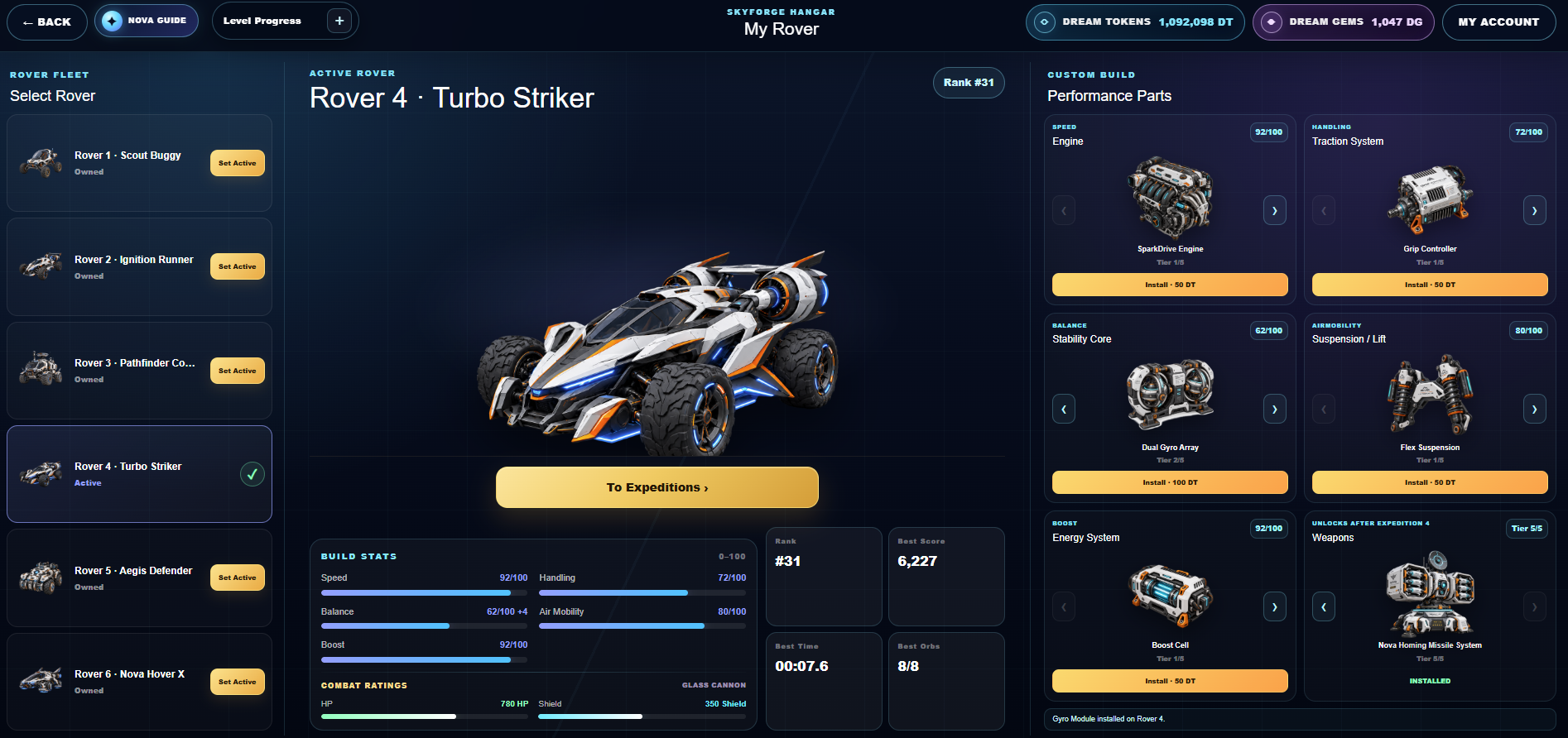
This is why Dreamscape does not treat rewards as a decorative badge system. The goal is for progress to accumulate into something the learner owns, manages or improves. The more meaningful that persistent world becomes, the more reason there is for the child to care about how they use what they earn.
Where NOVA+ fits into the system
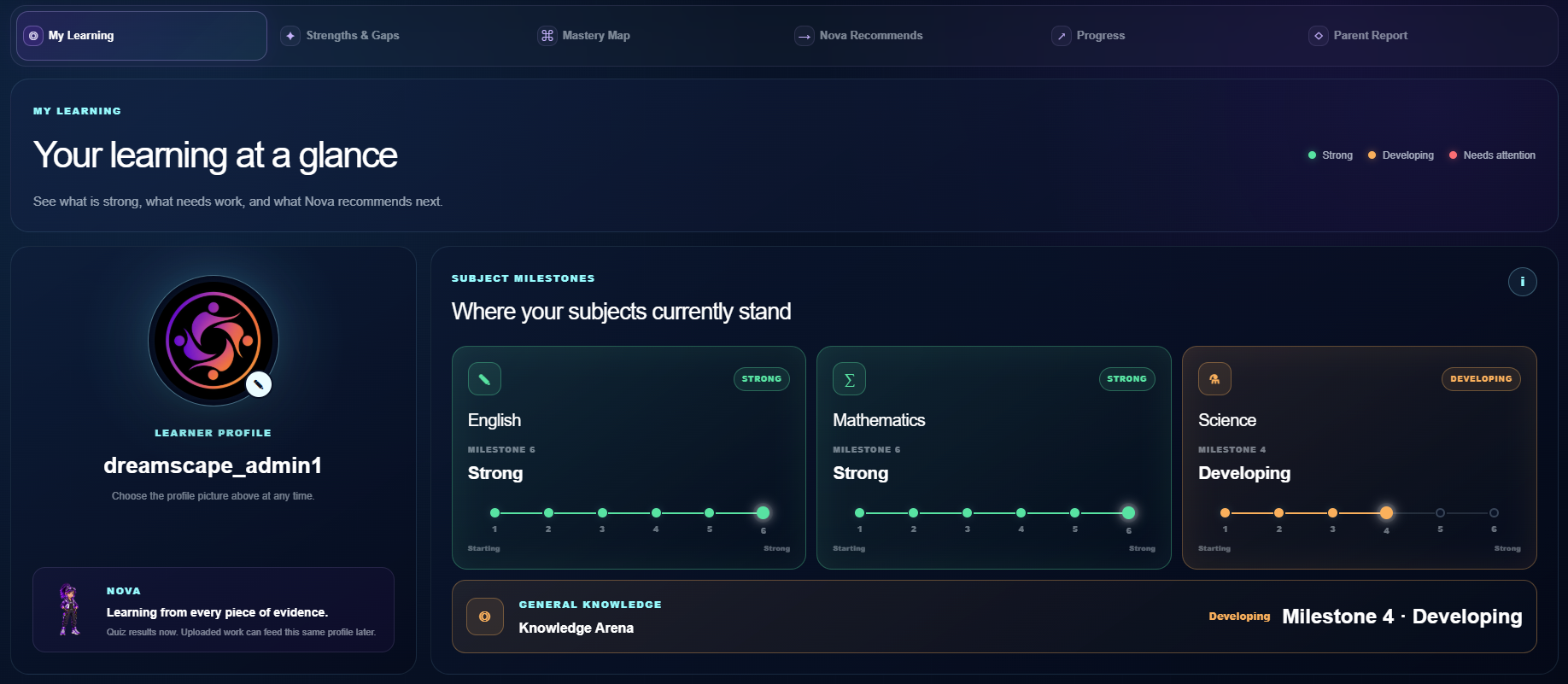
The child experiences the worlds. The parent needs a different view. NOVA+ takes learning activity and organises it into a parent-facing picture of progress, strengths, gaps and mastery.
My Learning gives a broader weekly view. Strengths & Gaps goes down to concept level. The Mastery Map organises evidence across the curriculum. Nova Recommends uses the available evidence to suggest what may be useful next. Downloadable reports make that picture easier to review away from the screen.
NOVA+ is not intended to diagnose a child or claim that platform data is the whole learner. It works with the evidence Dreamscape has. That makes the quality of the underlying curriculum mapping and learning activity important, which is why the intelligence layer is being built alongside the teaching engine rather than as a separate chatbot-style feature.
What a typical journey might look like
A learner could begin with a Mathematics mission, complete a set of questions and earn progress toward Dream Tokens. Later, they might use those Tokens on a rover upgrade or save them for something larger. A Think Lab challenge gives them a different kind of cognitive workout. Knowledge Arena lets them test what they know under a more energetic format.
As the learner becomes ready for Milo, those same ideas about limited resources become more explicit. Tokens can be spent, saved or placed into fictional assets. The child begins to see that every choice has an alternative they are giving up. Eventually, the Business Builder can make those trade-offs even more concrete through costs, staffing, operations and growth.
Meanwhile, the parent is not expected to watch every game. NOVA+ turns the academic evidence into a more useful summary so that the family can focus on the areas that matter.
Why the system is connected
It would be easier to build each feature as a separate mini-game. But that would weaken the central idea. Dreamscape works best when learning progress has consequences elsewhere, and when later decisions depend on resources or knowledge earned earlier.
The long-term aim is therefore not simply to increase the number of activities. It is to strengthen the connections between them. A good addition to Dreamscape should either improve how a learner learns, improve how they think, give their progress a more meaningful use, or help parents understand that progress more clearly.
What parents should expect
Dreamscape should be viewed as a learning environment, not a promise that motivation problems disappear or that every child will love every subject. Some activities are meant to be challenging. Some decisions will be wrong. Some concepts will need to be revisited.
The difference is that those experiences can become part of a larger story of progress. Parents can use NOVA+ to understand the evidence, while learners have a world that gives them more reasons to keep moving forward.
For a shorter introduction to the overall idea, read What Is Dreamscape One?
Continue with Dreamscape
Choose the part you want to understand next
Explore Nova’s learning world, Milo’s financial-literacy world, or the NOVA+ parent intelligence layer in more detail.
Continue Exploring