
Dreamscape Guide
What Is Dreamscape One?
Dreamscape One is a connected learning ecosystem designed to help children build strong academic foundations, think more independently, and gradually apply what they learn to choices about value, money, business and the real world.
Dreamscape One is not meant to be just another quiz website, and it is not a game with school questions placed on top. The larger idea is to give learning somewhere to go. A child can practise a concept, earn a reward from that progress, use the reward inside a wider world, and then encounter new kinds of choices as the experience grows with them.
For parents, the simplest way to understand Dreamscape is as a journey with several connected layers. Nova's World focuses on academic foundations and thinking. Milo's Worldextends the experience into money, business and decision-making. NOVA+ helps parents understand the learning evidence being generated along the way.
Dreamscape is designed around a progression: learn something, think with it, earn through progress, make choices, and eventually build or manage something with greater independence.
Why Dreamscape exists
Children still need practice. They need to read carefully, understand concepts, remember important knowledge, solve problems and become more accurate over time. The challenge is that practice can easily feel disconnected from anything the learner actually cares about.
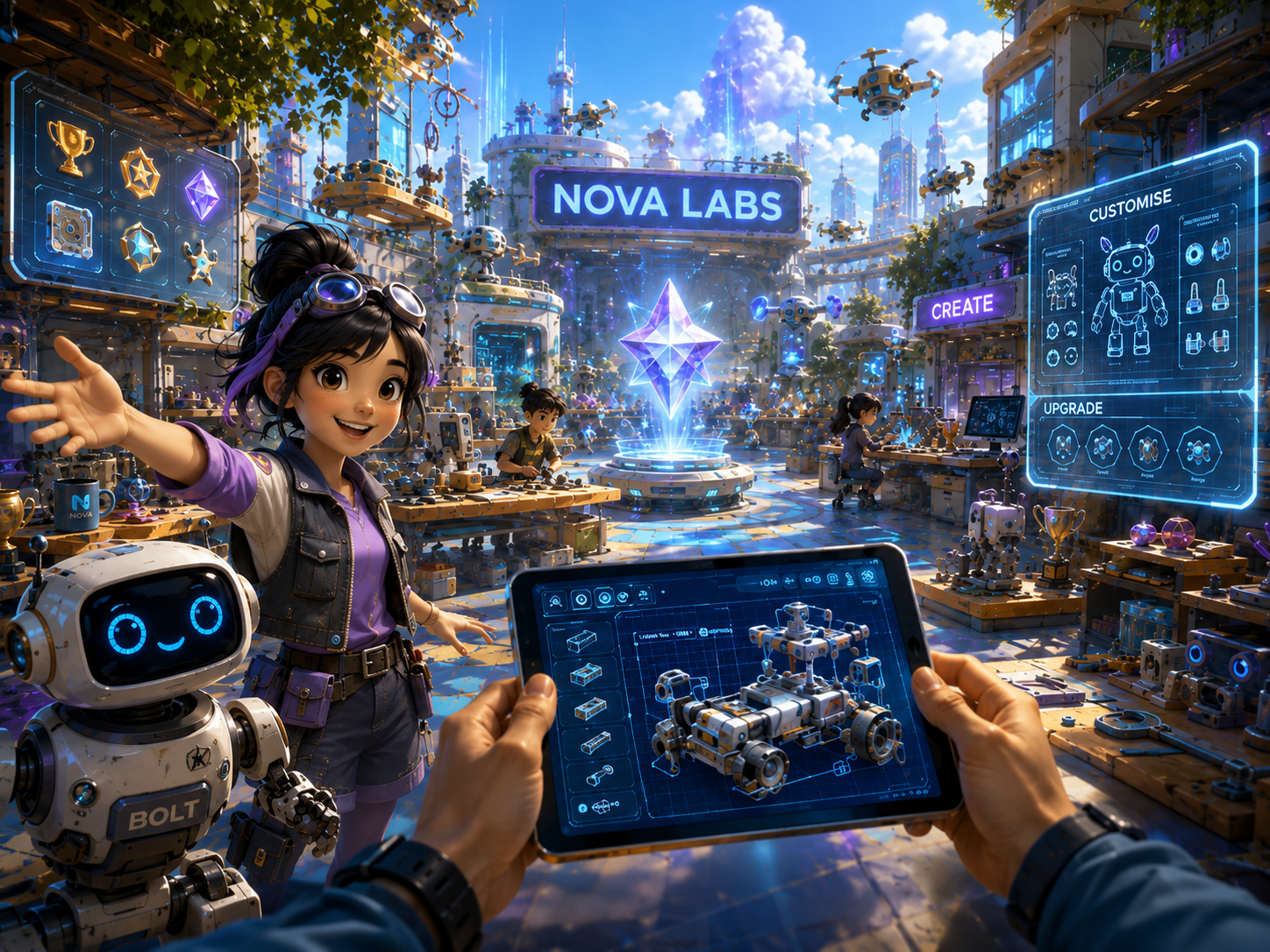
Dreamscape tries to solve that problem without pretending that learning can happen without effort. Instead of removing the work, it connects the work to a world with progress, ownership and consequence. Completing a learning activity can contribute to rewards, unlocks, upgrades and a growing sense that the learner is building something rather than simply finishing another worksheet.
Nova's World: build the foundations
Nova's World is designed around primary-school learning and the thinking skills that support it. Learners can move through curriculum practice, reasoning games, quiz challenges and world-building experiences while keeping the academic work connected to a larger journey.
The major areas include Learning Missions, the Think Lab, the Knowledge Arena, Nova's Home and the Skyforge Hangar. They do different jobs. Some are directly academic. Some build memory or reasoning. Others give the learner somewhere meaningful to use what they have earned.
This distinction matters. If every part of the platform simply asked another question, the rewards would eventually feel like more schoolwork in disguise. Dreamscape therefore separates learning, thinking and application while still allowing progress to flow between them.
Rewards make progress visible
Dreamscape uses two in-world reward currencies: Dream Tokensand Dream Gems. They have different roles, but both are intended to make progress feel tangible. Learners can see that effort has produced something they can use, save or spend inside Dreamscape.
Dream Tokens are the everyday virtual currency of the world. They can support play, upgrades, purchases and later financial decisions. Dream Gems are a more specialised learning reward connected to eligible activities. Neither is real money, and neither is designed to turn schoolwork into a cash transaction. Their purpose is to create a simple bridge between effort and consequence inside a safe virtual environment.
Milo's World: apply learning to choices
As learners become more independent, Dreamscape introduces a different type of challenge. Milo's World is designed mainly around ages 12+ because its games and decisions are more demanding, but it is not hard age-gated. A younger learner who is ready for the difficulty can explore earlier.

Milo moves beyond earning rewards and asks what a learner should do with them. Should you spend now or save? What happens when an asset rises or falls in value? What does risk feel like when a decision has a visible consequence? What happens when a business has costs, staff, limited resources and competing priorities?
The Activity Lab, Milo's Exchange, Dream Shop, Quiz Hall and the forthcoming Business Builder are designed around these kinds of choices. The stock and property markets are fictional and use Dream Tokens, so the purpose is learning and experimentation rather than real-money speculation.
NOVA+ gives parents a different view
A score can tell you whether a learner answered a set of questions correctly. It does not always tell you where the understanding is secure, which concepts are repeatedly causing difficulty, or how the picture is changing over time.
NOVA+ is Dreamscape's parent-facing learning intelligence layer. It brings together evidence from activity in the platform and organises it into views such as My Learning, Strengths & Gaps, the Mastery Mapand Nova Recommends. The aim is not to replace a teacher's judgement or reduce a child to a score. It is to make the evidence Dreamscape already has more useful to families.
NOVA+ is initially centred on English and Mathematics, where the strongest concept-level mapping and learning evidence are being built. Parents can also use downloadable reports when they want a more complete snapshot to review away from the dashboard.
What Dreamscape One is not
Dreamscape is not intended to claim that children learn simply because an experience looks like a game. It does not remove the need for focused practice, careful reading, persistence or instruction. It also does not treat every learner as though they should progress at the same pace.
The platform is better understood as an environment that tries to make those necessary parts of learning more connected. Academic work remains important. The difference is that the learner can see what that work is contributing to beyond the immediate score.
Who is Dreamscape for?
Nova is built primarily for primary-school learners. Milo is designed at a higher level, mainly for ages 12 and above, although capable younger learners can begin earlier. The two worlds do not have to be treated as a rigid age ladder. They are better thought of as different levels of complexity.
A younger child may spend most of their time strengthening English, Mathematics, Science and thinking skills in Nova. An older or more advanced learner may increasingly be interested in Milo's questions about value, ownership, risk and business. Over time, the balance can change with the learner.
The bigger goal
The long-term direction of Dreamscape One is straightforward: children should leave learning with more than correct answers. They should become increasingly able to use knowledge, make thoughtful decisions, manage trade-offs, understand consequences and build things of their own.
That is why the platform begins with school mastery but does not end there. The worlds are designed to connect what children learn today with the kinds of judgement and independence they will need later.
If you want to see the system step by step, continue with the full How Dreamscape One Works guide.
Continue with Dreamscape
See how the pieces connect
Follow the Dreamscape journey from curriculum learning to thinking, rewards, decision-making and building.
Continue Exploring